PRODUCT
- Contact:0536-3344577
- Contact:0536-3344677
- fax:0536-3344166
- telephone:+86-18605361716
Product Overview
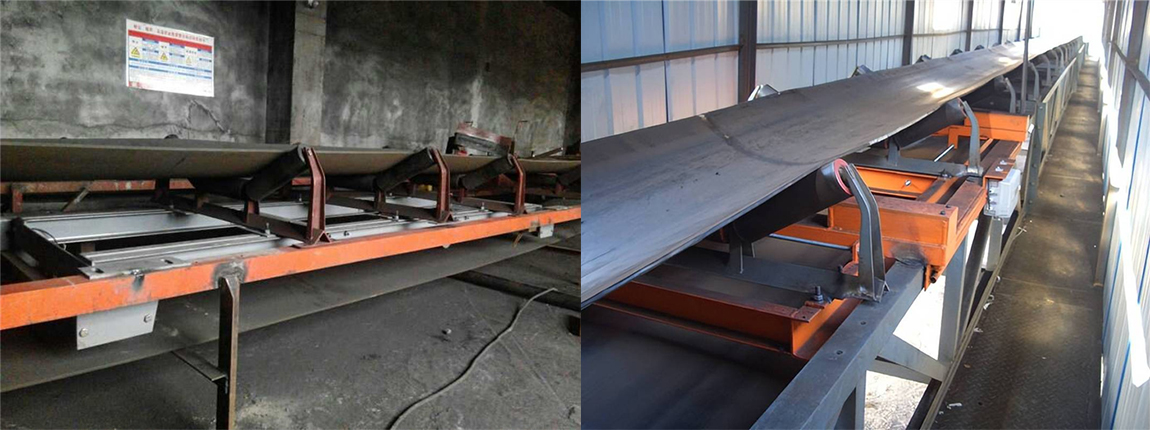
The through-type electronic belt scale, also known as the automatic metering scale for belt conveyors, is a new type of metering equipment developed by our company on the basis of introducing, digesting, and absorbing advanced foreign technologies. This machine can be easily installed on an existing conveyor belt, and without affecting its conveying function, it can automatically measure the weight of bulk granular materials transported by the belt. It features a simple structure, high weighing accuracy, ease of use, and minimal maintenance requirements. It is suitable not only for conventional environments but also for acidic, alkaline, salty, and atmospherically corrosive environments. It is widely used in industries such as building materials, electric power, coal, mining, metallurgy, chemical engineering, grain, ports, and docks. Its main technical indicators have reached the advanced level of similar foreign products.
Working Principle and System Composition
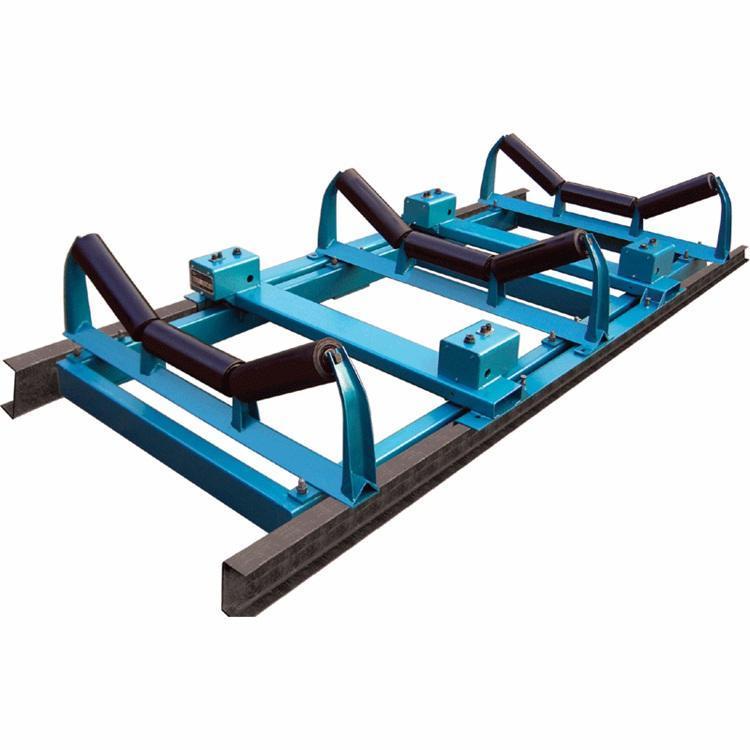
The ICS series electronic belt scale consists of four main components: load-bearing frames, a weighing bridge, a speed sensor, and an integrator.
Two load-bearing frames equipped with load cells are mounted on the longitudinal beams of the conveyor. The weighing bridge is placed on these load-bearing frames, and weighing idlers are installed on the weighing bridge. The aforementioned mechanical structure detects the weight of materials on the belt and generates an output signal proportional to the belt load.
The speed sensor is directly connected to one of the load-bearing frames and pressed against the back of the return belt. It provides a series of pulses, where each pulse represents a unit distance of belt movement, and the pulse frequency is proportional to the belt speed.
The integrator receives signals from the load cells and the speed sensor. Through the corresponding calculations of the microprocessor inside the integrator, it multiplies the belt running distance by the belt load. By calculating over time, an instantaneous flow rate value and a cumulative total are generated. The instantaneous flow rate and cumulative total are converted into selected engineering units (kilograms, tons, pounds) and displayed on the monitor respectively.
Features
◆Can be easily installed on an in-service belt conveyor.
◆Adopts a high-speed pulse speed-measuring sensor to accurately measure the linear speed of the conveying belt.
◆Uses high-precision metal-sealed load cells, featuring high measurement accuracy and good stability.
◆The on-board electronic control system is available in multiple configurations for different user needs.
◆Can be retrofitted directly on the existing conveying belt, enabling easy installation and maintenance.
◆Suitable for conveying belts with a width of 500~2000mm.
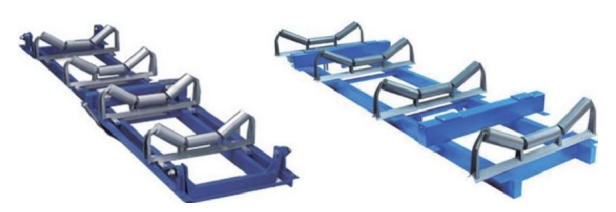
◆Depending on the user's on-site conditions, single-idler, double-idler, triple-idler, and four-idler options are available.
Main Technical Indicators

Belt Width: 500-2200mm
Belt Speed: 0.1-4m/s
Metering Accuracy: ±1%
Power Supply: ~220V 50Hz
Upper Flow Limit: Relay contact output
Lower Flow Limit: Relay contact output
Ton Pulse: Cumulative unit can be set arbitrarily
Instantaneous Flow Rate: Kg/min (4-20mA)
Combined Scale Body, Multi-Idler or Single-Idler Structure, Weighing Mechanism